Clinical Studies
Botulax safety & efficacy
Botulax has undergone numerous clinical trials, proving its efficacy and safety upon injection. Studies compared it with other prominent botulinum toxin brands, such as Allergan’s Botox, and Botulax has demonstrated comparable effectiveness. The following studies demonstrate Botulax’s excellent effects on various signs of aging.
Glabellar linesBlepharospasmUpper limb spasticityCerebral palsy
Comparative clinical study of Botulax and Botox for the improvement in glabellar lines
Subjects
Two hundred seventy-two (272) healthy adult male and female patients aged 18 to 65 with moderate to severe glabellar lines at maximum frown.
Methodology
A multicenter, double-blind, randomized, active-controlled comparative, Phase III clinical trial
Safety
There was no noticeable difference in the safety profile between Botulax and Botox
Conclusion
This clinical trial proved that the glabellar line improvement effect of Botulax is not inferior to that of Botox in patients with moderate to severe glabellar lines. Therefore, Botulax is considered to be an effective and safe treatment option other than Botox.
| Group | Botulax (Improvement rate (%)) | Botox (Improvement rate (%)) |
|---|---|---|
| FAS (Full Analysis Set), 4 weeks | 90.30 | 81.34 |
| FAS (Full Analysis Set), 8 weeks | 70.90 | 64.93 |
| PPS (Per-Protocol Set), 4 weeks | 89.34 | 81.89 |
| PPS (Per-Protocol Set), 8 weeks | 72.03 | 65.87 |
Reference: Kim, B.J., Kwon, H.H., Park, S.Y., Min, S.U., Yoon, J.Y., Park, Y.M., Seo, S.H., Ahn, J.Y., Lee, H.K. & Suh, D.H. (2014). Double-blind, randomized non-inferiority trial of a novel botulinum toxin A processed from the strain CBFC26, compared with onabotulinumtoxin A in the treatment of glabellar lines. Journal of the European Academy of Dermatology and Venereology, Vol. 28, Issue 12.
Comparative clinical study of Botulax and Botox for the treatment of blepharospasm
Subjects
Two hundred twenty-five (225) patients diagnosed with essential blepharospasm and grade 2 to 4 spasms (Scott Method)
Methodology
A multicenter, double-blind, randomized, active-controlled comparative, Phase III clinical trial
Safety
No clinically significant adverse event was observed. There were also no substantial differences between Hugel-Tox (now known as Botulax) and Botox in clinical efficacy and duration.
Conclusion
The efficacy of Botulax is not inferior to that of Botox. Botulax is considered to be effective and safe in treating essential blepharospasm.
| Group | Botulax (Improvement rate (%)) | Botox (Improvement rate (%)) |
|---|---|---|
| ITT group, Effectiveness | 94.20 | 93.27 |
| PP group, Effectiveness | 98.91 | 100.00 |
| Group | Botulax (Duration (days)) | Botox (Duration (days)) |
|---|---|---|
| ITT group, Duration | 121 | 120 |
| PP group, Duration | 131 | 134 |
Reference: Lee, J.H., Jung, S.K., Baik, J.S. & Yang, S.W. (2015). Comparative Study of Hugel-tox versus Botox for the Treatment of Essential Blepharospasm. J Korean Ophthalmol Soc 2015;56(6):811–814.
Comparative clinical study of Botulax and Botox for the improvement in post-stroke upper limb spasticity
Subjects
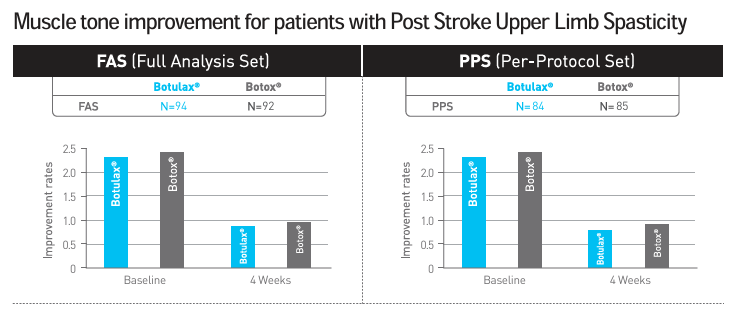
One hundred eighty-six (186) patients aged 20 or above who were diagnosed with stroke and had a MAS score of ≥ 2 points for focal muscular spasticity in the wrist flexor and ≥ 1 point for muscular spasticity in one or more of the elbow flexors and finger flexors.
Methodology
A multicenter, double-blind, randomized, active-controlled comparative, Phase III clinical trial
Safety
No clinically significant adverse event was observed.
Conclusion
Results from this study demonstrated non-inferiority of Botulax to Botox in terms of muscle tone improvement for patients with post-stroke upper limb spasticity, as well as comparative equivalence in safety. Therefore, Botulax is considered to be an effective and safe treatment option for patients with post-stroke upper limb spasticity.
Reference: Do KH, Chun MH, Paik NJ, Park YG, Lee SU, Kim MW, Kim DK. Safety and efficacy of letibotulinumtoxinA (BOTULAX) in treatment of post-stroke upper limb spasticity: a randomized, double blind, multicenter, phase III clinical trial. Clin Rehabil. 2017 Sep;31(9):1179–1188.
Comparative clinical study of Botulax with Botox for the improvement in children with cerebral palsy
Subjects
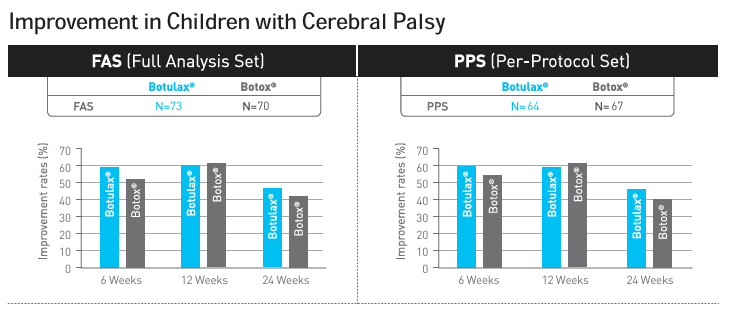
In the study, about 144 cases of dynamic equinus foot deformity in children with cerebral palsy (study group: 72 cases, control group: 72 cases) were included, and the patients were diagnosed according to GMFCS (Gross Motor Function Classification System) Level I, II or III.
Methodology
Double-blind, randomized, active-controlled, multicenter-designed, Phase III clinical trial.
Safety
In analysis for safety assessment, differences between the Botulax Inj. group and the Botox Inj. group were not statistically significant.
Conclusion
Non-inferiority was demonstrated for Botulax Inj. used for treatment of equinus deformity in children with cerebral palsy to Botox Inj. in terms of the responder rate (the proportion of subjects with a 2 or more points increase in the PRS at Week 12 post-dose from baseline).
Reference: Chang HJ, Hong BY, Lee SJ, Lee S, Park JH, Kwon JY. Efficacy and Safety of Letibotulinum Toxin A for the Treatment of Dynamic Equinus Foot Deformity in Children with Cerebral Palsy: A Randomized Controlled Trial. Toxins (Basel). 2017 Aug 18;9(8):252.
Talk to the Botulax USA team
For questions about product availability, specifications, documentation, or professional purchasing, please contact our team.